Defense tech is having its moment. Investors put more than $14.6 billion into military and national-security startups in just the first five months of 2026, already ahead of 2025’s full-year record of $9.6 billion. Anduril is valued at $61 billion. Shield AI sits at $12.7 billion. The capital is real, and it’s moving fast.
What a lot of founders in this category haven’t priced in is that they’re carrying a second balance sheet, one investors don’t ask about in diligence calls, but that quietly determines whether the first one holds up. That’s reputation. For dual-use companies in particular, it’s more exposed and more contested than in almost any other corner of tech right now.
The math nobody puts in the pitch deck
Ocean Tomo’s fifty-year study puts intangibles at roughly 92% of S&P 500 market capitalization as of the end of 2025, up from 32% in 1985. It’s a broad number, market value minus tangible book value, not a precise inventory of brand and goodwill. But the trend line has held for fifty years without exception.
Echo Research puts reputation’s specific share of that intangible value at $11.9 trillion, roughly 28% of it. Ask executives directly and they put the number higher. A 2020 Weber Shandwick survey of 2,227 executives across 22 markets found they credit reputation with 63% of total market value. The exact multiple depends on who’s counting. That it’s a multiple at all, worth trillions rather than millions, is the part nobody disputes.
For a founder raising a Series C or preparing a first defense-sector IPO, that’s not a marketing stat to skim past. It’s a line item that doesn’t appear on the balance sheet, and due diligence will price whether or not you’ve managed it.
A peer-reviewed study of the Volkswagen emissions scandal found the reputational hit to shareholder value ran up to five times the initial operational loss. Wells Fargo’s fake-accounts scandal broke in 2016; eight years on, YouGov’s brand tracking still showed its reputation and recommendation scores in negative territory. For a company mid-raise or mid-procurement cycle, that kind of multi-year drag isn’t a brand problem. It’s existential.
The Dual-Use Challenge
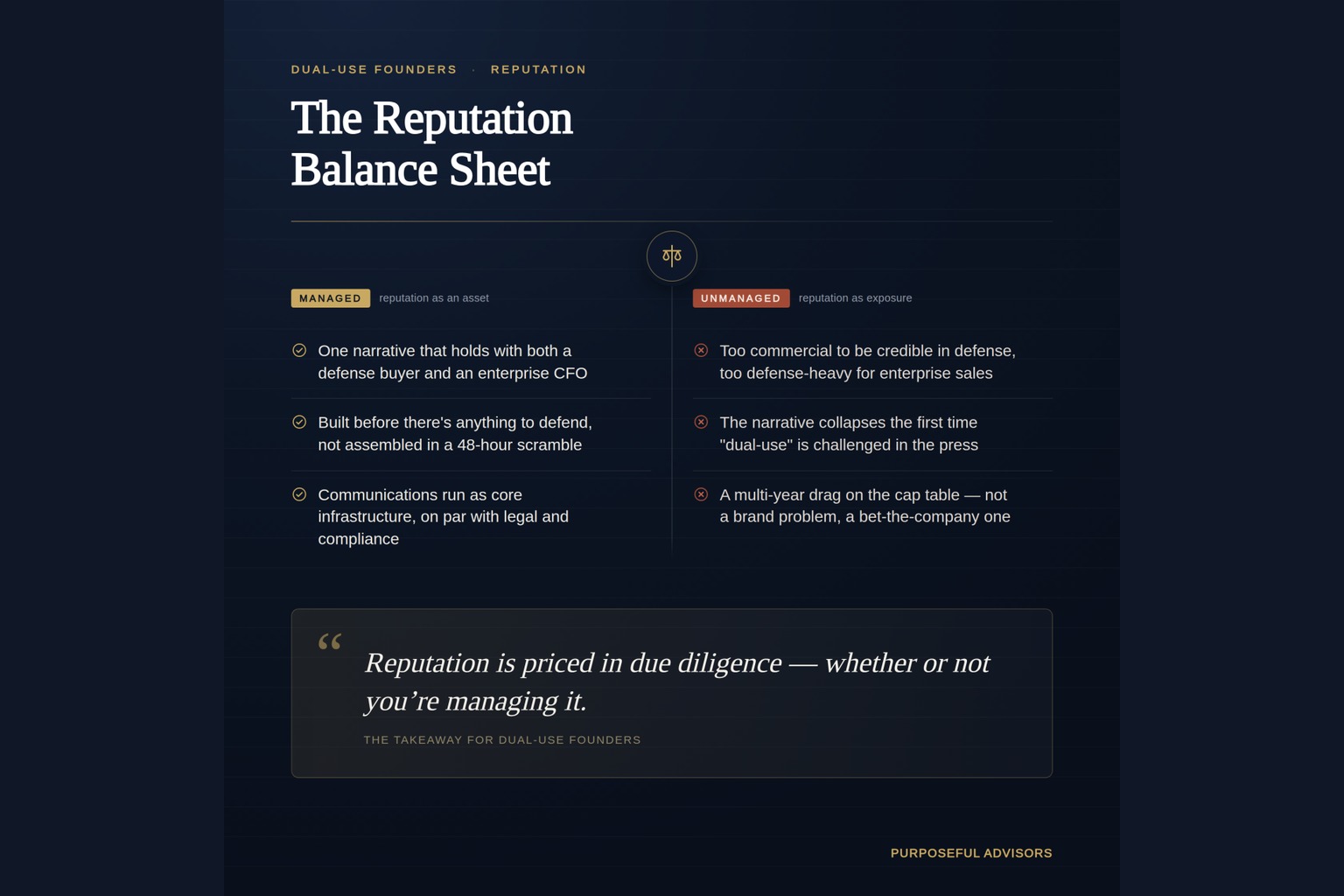
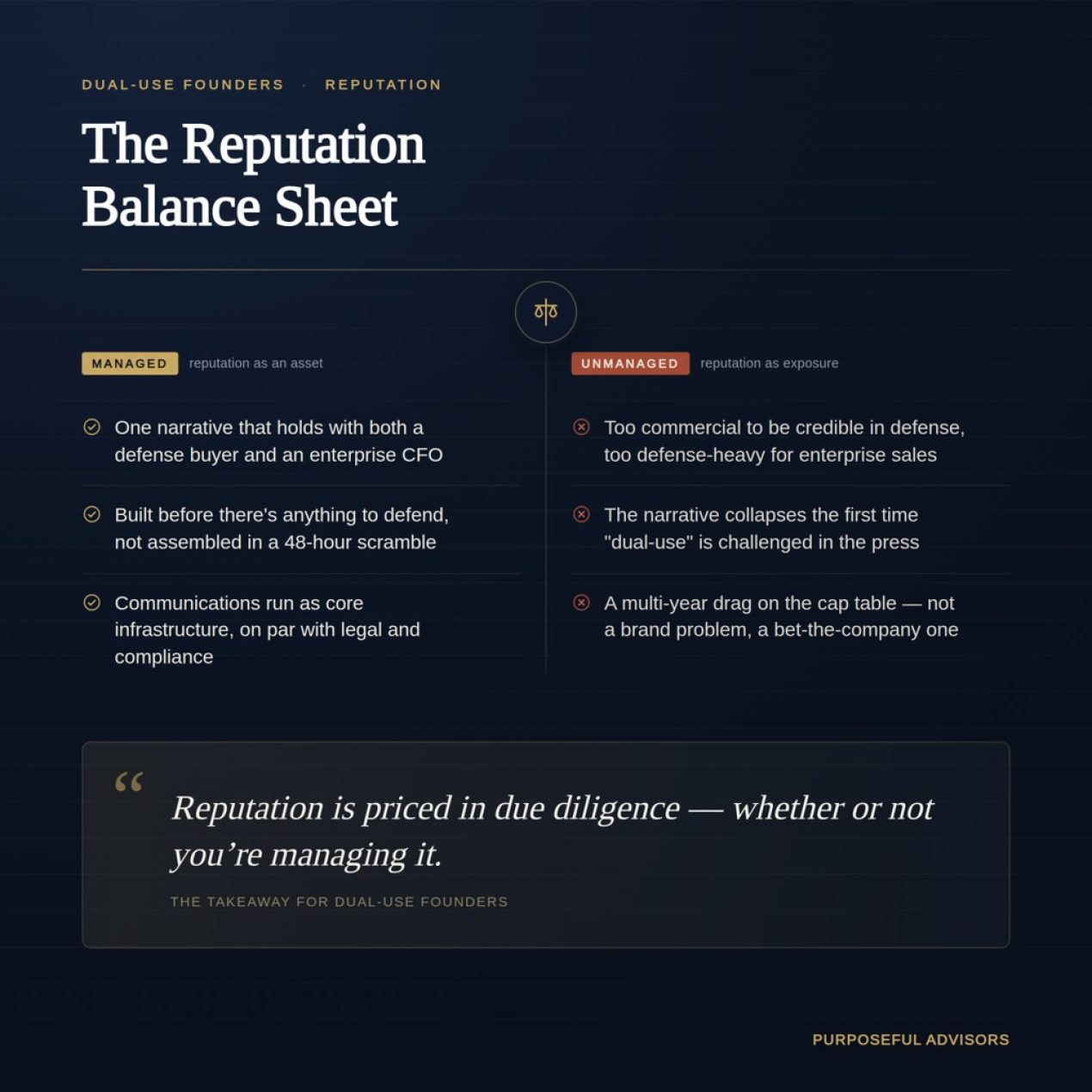
Most startups build one narrative for one audience. Dual-use companies have to hold two: commercial buyers and defense or government stakeholders, who often read the exact same signal in opposite ways. People who advise these companies for a living describe the trap plainly. Without a deliberate brand strategy, a dual-use company ends up looking too commercial to be taken seriously in defense, or too defense-heavy to fit into enterprise sales.
Even the category label is under pressure. A widely discussed 2026 piece in The Defense Post argues that “dual-use” assumes a clean split between civilian and military technology that doesn’t really exist anymore in modern conflict; every company wearing that label inherits some of the ambiguity.
Public sentiment compounds the exposure. A March 2026 Economist/YouGov poll found Americans nearly three times more likely to expect negative effects from AI than positive ones, and more likely to say AI companies should be able to restrict military use of their tools than to say the military should use them however it wants, 44% to 25%. That stopped being theoretical in March, when the Pentagon designated Anthropic a “supply chain risk” and canceled its contracts after the company refused to allow Claude to be used for autonomous weapons or domestic surveillance. Anthropic sued, won a preliminary injunction on March 26, and lost it on appeal thirteen days later. Who gets to say no is not a settled question. It is being litigated right now, under every AI-adjacent defense vendor in the market.
What it looks like when this goes wrong
Palantir’s 2026 “manifesto” post is a good, recent example. It touched on national service, the moral duty of tech companies in defense, and cultural hierarchy, and the backlash was fast. It got mocked across mainstream tech press and fed directly into a broader European retreat from the company.
For a dual-use company mid-raise, mid-procurement cycle, or heading toward an IPO (Anduril has said it’s “definitely” going public at some point), that kind of multi-year drag isn’t just a brand problem; It’s a bet-the-company problem.
What it looks like when reputation is actually managed
The flip side is just as measurable. Companies that get ahead of a reputational threat instead of reacting to it are roughly 40% more likely to fully restore their standing. That’s the whole argument for building reputation deliberately, before there’s a crisis, instead of assembling something in a 48-hour scramble after the fact.
For dual-use leadership, that means starting the work before there’s anything to defend: a narrative that holds up equally well to a defense procurement officer and an enterprise CFO, positioning that doesn’t fall apart the first time “dual-use” gets challenged in the press, and a communications function treated as core infrastructure, on par with legal and compliance, rather than something bolted on after Series B.
The takeaway for founders and CEOs
Capital is flowing into this sector at a record pace, and the scrutiny is scaling right along with it, from Congress, from allied governments, from your own employees, and from a public that’s measurably wary of how this technology actually gets used. Companies that treat reputation as an asset worth building and protecting, with the same rigor as their cap table or their compliance program, are the ones still standing when that scrutiny shows up. The ones that don’t will find out, the way Palantir did this year, just how quickly a single moment can turn into policy.
Purposeful Advisors partners with founders and leadership teams building in highly regulated, high-scrutiny industries to build and protect the reputational asset that increasingly determines enterprise value.