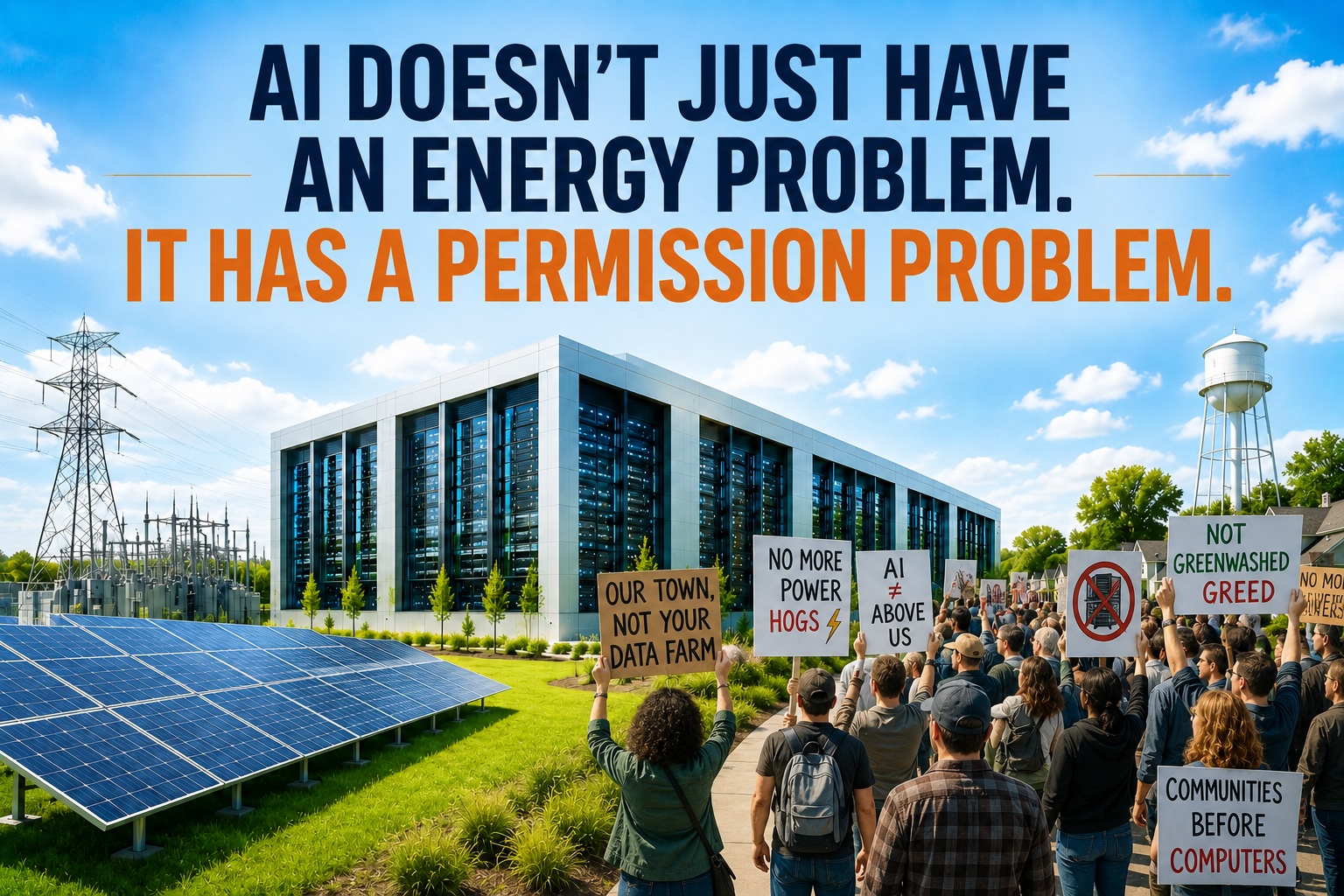
Last year, Pennsylvania Governor Josh Shapiro was boasting about landing a huge AI data center. Last month he imposed strict new requirements on the next ones. Texas Governor Greg Abbott froze new data centers outright. In Michigan, the Republican Senate nominee is backing a one-year moratorium. Top Republicans are telling reporters that data centers alone could cost them control of the Senate.
Utilities have raised their forecast for peak demand growth sixfold in just three years. PJM, the country’s largest grid operator, has seen capacity prices jump 11x, and utilities are passing that through to the monthly bill.
An entire industry has formed to solve AI’s power problem. Almost nothing has formed to solve its permission problem, and the permission problem is now the bigger one.
Permission, here, doesn’t mean a permit. It means the ongoing consent of the communities, policymakers, utilities and regulators who decide whether the infrastructure AI needs actually gets built.
So the engineering talent has arrived. Advanced cooling, on-site generation, grid management, storage, small nuclear, geothermal, chips that squeeze more compute out of every watt. Some of the most interesting companies being created around AI are the ones solving the problems AI itself is creating. Venture capital knows this. There are funds, conferences and analyst categories devoted to it.
The AI infrastructure problem has become a political problem
Carbon Direct counted 46 AI data center projects across 20 states that were blocked, withdrawn or stalled between January 2024 and May 2026, representing more than $170 billion in announced investment. Six cancellations in 2024, 25 in 2025, and more than 20 in the first five months of this year. Data Center Watch’s Q1 2026 report, covered by Axios, counted at least 75 projects worth roughly $130 billion affected in that quarter alone.
That is a larger number than most of the energy-technology markets attracting all that capital. And the response to it, so far, amounts to the tried and true town hall. The instinct is to treat the opposition as an argument about water and electricity, and to assume that better numbers will settle it. The sentiment data suggests otherwise.
Gallup finds more than 70% of Americans oppose construction of a data center in their area, more than oppose a nuclear plant. In Virginia, the industry’s home turf, support has fallen sharply in three years. Nearly two-thirds of the blocked investment Carbon Direct identified sits in counties that voted Republican in 2024, and the political ads running on data centers this cycle are overwhelmingly against them. Conservative farmers, environmental activists and local officials who agree on nothing else have found something to agree on.
Meanwhile the water argument, on the merits, is weaker than its headlines. A separate CRS look at data centers and water use puts their direct consumption at roughly 2% of total U.S. water use, a far smaller number than the coverage implies. That fact has changed exactly no one’s mind, because the fight is happening in a specific watershed, on a specific electricity bill, over a specific piece of farmland.
Here is the part that matters most
When Carbon Direct looked closely at how opposition formed, the most consistent drivers were process and transparency. Closed-door negotiations, undisclosed resource requirements, opaque ownership structures and NDAs binding local officials generated opposition faster than the environmental issues themselves.
People are not primarily angry about the megawatts. They are angry that nobody asked them, and they suspect their local government is being taken advantage of by a company that doesn’t care about them. Both of those are perception problems, and both are largely self-inflicted.
If the first serious conversation with a community happens when hundreds of people show up at a planning meeting angry about a project they believe was negotiated behind closed doors, that’s an operating problem, not a communications one.
Reputation risk becomes enterprise-value risk remarkably quickly
Community opposition sounds like a soft metric. The impact on valuation isn’t.
A project meets resistance. A permit slips. A commissioning date moves six months. Customer commitments loosen. Capital sits idle longer than expected. Financing costs rise. The next project gets extra scrutiny because of what happened to the first one.
Policymakers want AI infrastructure built. Communities are asking for guarantees before groundbreaking, not after. Those two forces are going to collide repeatedly. Companies that understand how to operate inside that tension will have an advantage.
Better technology helps. But it doesn’t eliminate the permission problem.
There is a temptation, especially among founders building efficiency technology, to assume they sit on the right side of this fight.
Our cooling uses less water. Our power system reduces grid dependency. Our software makes the facility dramatically more efficient. Our distributed model means no giant building at all.
Those are excellent answers to engineering questions. Communities ask different questions. Who benefits? Who pays? What happens to my bill? What happens if your assumptions are wrong? Who is actually behind this project? Why are we hearing about it now?
The companies that get built will be the ones that can answer both sets of questions, and can do it before the first hostile planning meeting rather than after.
Founders should start engaging with the public much earlier
That means knowing who can influence the outcome: mapping the regulators, utilities, political stakeholders, community groups and likely opponents, and identifying the arguments against a project before someone else frames them for you. Most of all, it means describing the value of the technology in terms that matter outside the company.
Less strain on the grid. Less water. Less disruption. A company helping make AI economically and socially sustainable is a very different story than “just another AI company.”
If you’re building or backing something in this space, the time to think about your permission strategy is now, not after the first town hall goes badly. We’d welcome the conversation.
frank@purposefuladv.com
About Purposeful Advisors
Purposeful Advisors is a senior-led strategic communications and reputation advisory firm. We work with founders, investors, and leadership teams at the moments when perception affects business value: capital raises, new market entry, building visibility, navigating issues, or leveling up the company story.
We’re built as an alternative to the traditional agency model. There’s no layer of account staff between you and the work. You work directly with senior advisors who’ve spent their careers inside major companies and institutions, advising CEOs, boards, investors and founders. Our experience spans technology and AI, defense technology and dual-use innovation, financial services and investment, venture and private capital, professional services, life sciences, sustainability and advanced manufacturing.