Most leadership teams treat it as a communications function: something to activate after the strategic decisions have already been made. A press release once the deal closes. A statement once the crisis breaks. A campaign once the round is announced. That approach gets the sequence backward, and the data increasingly makes the case for why.
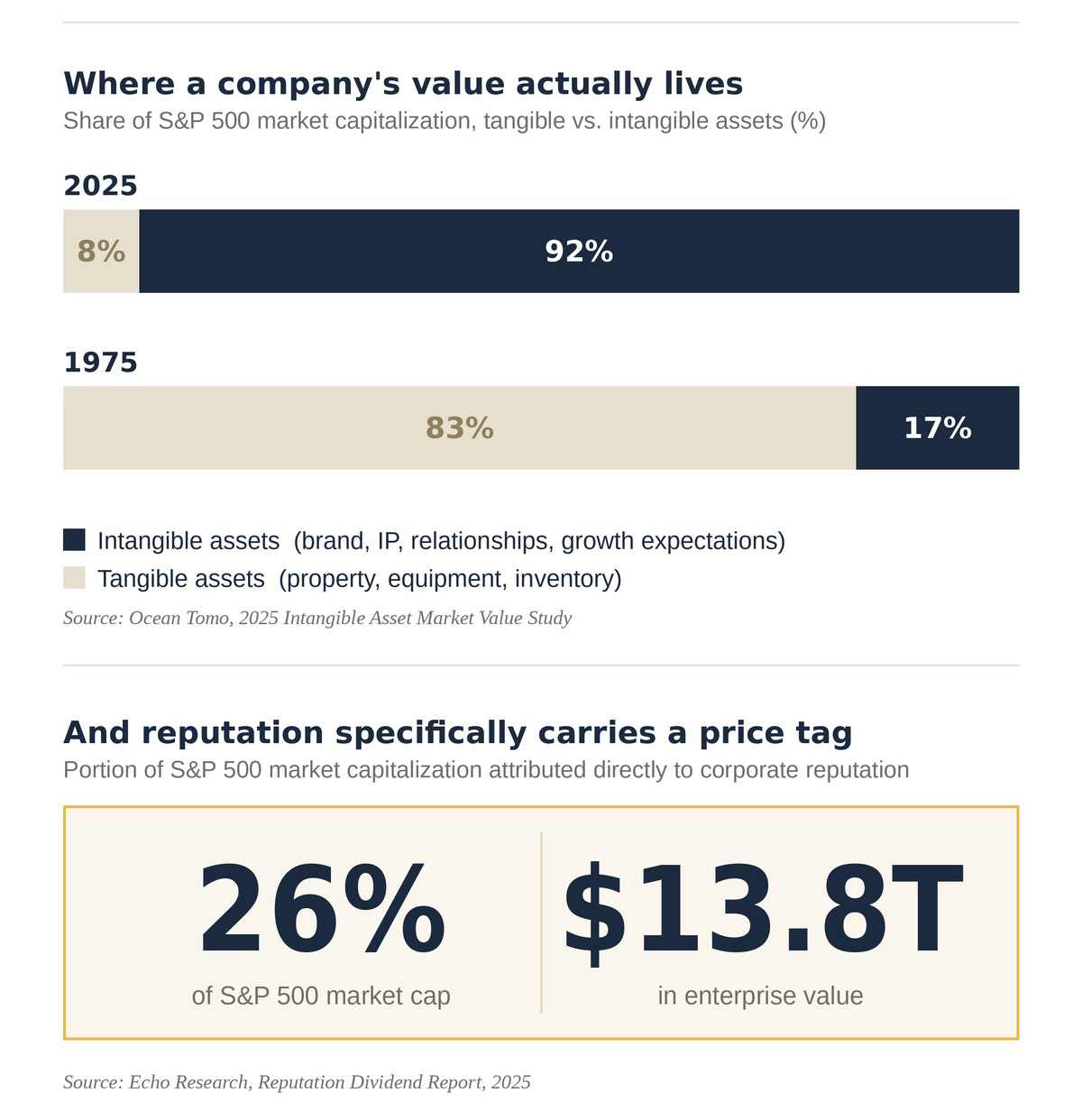
Start with the balance sheet, or rather, what’s missing from it. In 1975, tangible assets (property, equipment, inventory) made up 83% of the market value of the S&P 500. Today, according to Ocean Tomo’s 2025 Intangible Asset Market Value Study, that ratio has almost completely inverted: intangible assets now account for roughly 92% of S&P 500 market capitalization. The value of a modern company lives almost entirely in things you cannot touch: its brand, its relationships, its trust, its reputation.
Reputation itself is a meaningful piece of that. Echo Research’s 2025 Reputation Dividend analysis attributes roughly 26%, or $13.8 trillion, of S&P 500 market capitalization directly to corporate reputation. Weber Shandwick has found executives themselves estimate the number even higher, an average of 63% of a company’s market value, in their own assessment, tied to how the company is perceived. The range varies by methodology, but the direction doesn’t: a fifth to two-thirds of what a company is worth has nothing to do with what’s sitting in its warehouses, and everything to do with what stakeholders believe about it.
I’ve spent my career on the inside of that gap, advising companies from early-stage, venture-backed startups through public companies navigating IPOs, M&A, and crisis. And the pattern holds at every stage. The earliest-stage founder pitching a seed round and the CEO of a public company managing an activist investor are, in a very real sense, doing the same thing: asking a set of stakeholders to trust them with something valuable, before there’s enough hard evidence to fully justify that trust. Reputation is the bridge across that gap. It’s not a nice-to-have layered on top of the business. In the earliest and latest stages of a company’s life, it often is the business.
Reputation is not built through messaging
It is built through decisions.
Every material decision a company makes sends a signal: to investors, to employees, to customers, to regulators, to future hires. Markets don’t simply judge what a company says. They judge what it does, why it does it, and whether its actions are consistent over time. This is precisely why reputation can’t sit at the end of the process, downstream of the decision. It has to sit at the beginning, in the room where the decision gets made.
I’ve watched this play out from both ends. Venture investors will tell you, and research on founder evaluation backs this up, that the decision to back a founder comes down to how that person behaves under pressure. How they respond to bad news. How they lead when the plan falls apart. That matters far more than the specifics of the pitch deck. The outcome of a founder’s last company matters less than how they conducted themselves inside it. That’s reputation, formed in real time, well before there’s a product to point to.
At the other end of the spectrum, Deloitte’s board survey research found that reputation now rates as the highest-impact strategic risk area across nearly every industry, ahead of financial, regulatory, and operational risk. And yet the same research found a striking gap: 76% of board members believe their company would respond effectively if a crisis struck tomorrow, while less than half have actually taken the steps to be ready. That gap between confidence and preparation is where reputational value gets destroyed. Deloitte has also found that companies facing a severe reputational crisis can lose up to 30% of their market value within days. Not quarters. Days.
The hardest questions are rarely communications questions
They’re questions of leadership.
What are we actually trying to achieve? Which stakeholders determine whether we succeed? Where are the risks no one has named yet? What decision creates the greatest long-term value, not simply the cleanest headline tomorrow morning?
Answer those questions well, and communications becomes an amplifier. Answer them poorly, and communications becomes damage control. I’ve seen both versions of this dozens of times over, across companies of every size, and the difference is almost never the quality of the press release. It’s whether reputation was considered before the decision was made or bolted on after.
Trust is also shifting, and business is winning it
The 2026 Edelman Trust Barometer found that business is now more trusted than government globally: 64% versus 53%. For the first time, business is also seen as more ethical than NGOs. Employers specifically are the most trusted institution measured, at 78% trust among their own employees. That’s not a marginal shift. It means the burden, and the opportunity, of being a trusted institution has moved onto companies and their leaders. Edelman also found that 73% of people now expect the CEO personally to lead the effort to build that trust, not the communications department.
That’s the world today’s leadership teams are actually operating in. Reputation isn’t a soft metric sitting next to the real business. Increasingly, it is a primary input into enterprise value, investor confidence, capital access, and talent retention: measured, tracked, and priced by the market in real time.
Why we built Purposeful Advisors
Reputation as a leadership discipline rather than a communications function is exactly why we built Purposeful Advisors. Not as another communications agency, but as a firm of senior operators who help leadership teams think through defining moments before they become defining headlines. Raising capital. Entering a new market. Navigating an acquisition. Preparing for a crisis. Repositioning a company for growth. The role is always the same: bring strategic judgment before tactical execution.
I’ve always believed that reputation is one of the few assets capable of increasing enterprise value without ever appearing on the balance sheet. The data backs that belief up more concretely every year. The companies that understand this don’t wait until they have a communications problem. They treat reputation as a strategic advantage from the outset: at the seed stage, at the IPO, and every defining moment in between.
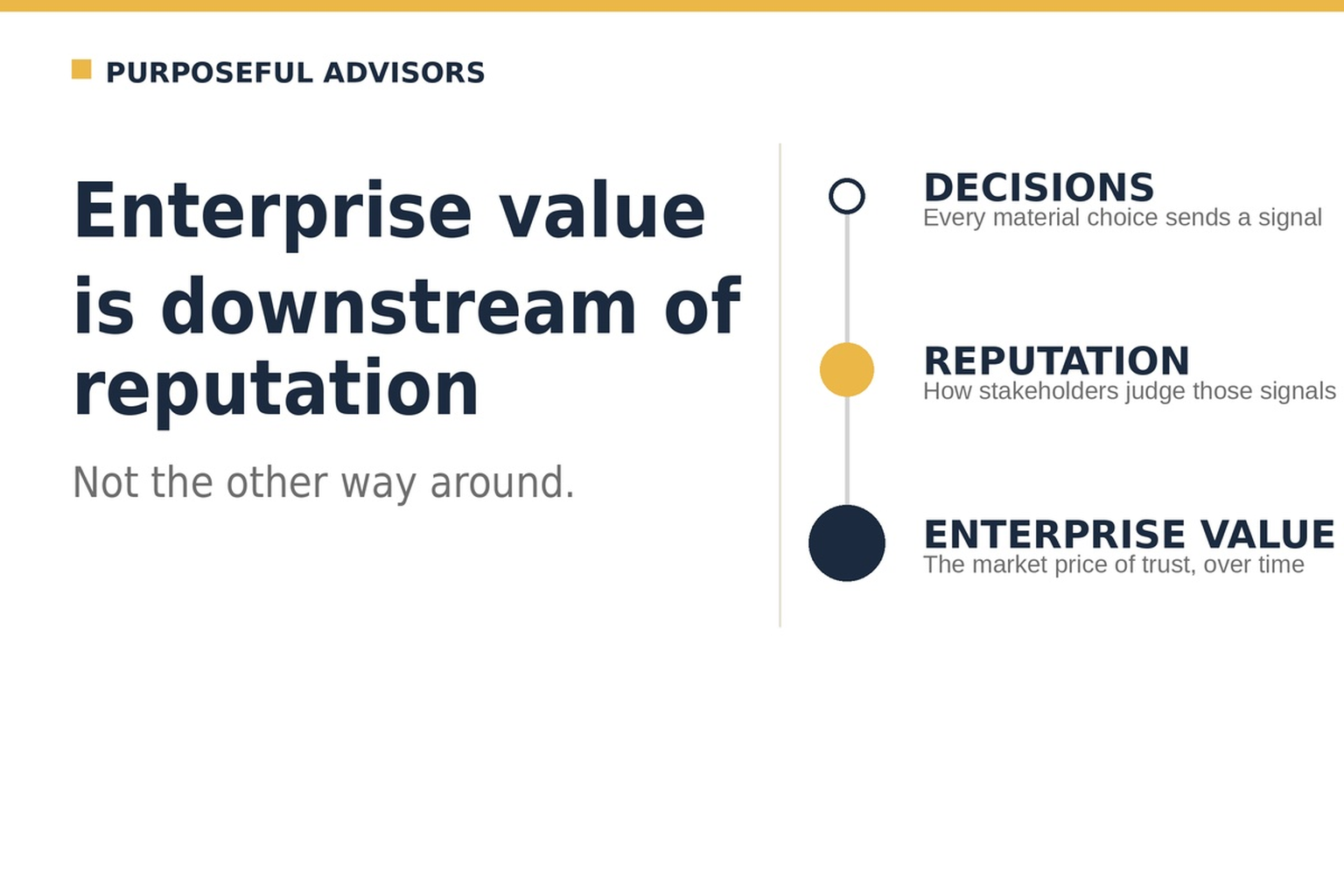
Enterprise value is downstream of reputation. Not the other way around.